

When I heard that U.S. forces are preparing to move around 7,000 ISIS detainees from Syria to Iraq “for trial,” my first reaction was suspicion. Not because I enjoy conspiracy theories, but because the Middle East has been living inside the consequences of Western “counterterrorism” for two decades. We have learned, the hard way, that Washington’s language is often moral, while its behavior is transactional. Words like “justice,” “stability,” and “security” are frequently the polite wrapping paper around something else: leverage.
And ISIS—whether Americans admit it or not—has been leveraged before.
To understand why this transfer is alarming, you have to go back ten years.
When ISIS had momentum—when it established its so-called caliphate in Raqqa and expanded across eastern Syria and western Iraq—the U.S. built an anti-ISIS campaign with local forces, especially the Kurdish-led formations that later became the SDF. ISIS commanders, operatives, and foreign fighters were captured in large numbers. Many were held in makeshift detention facilities in Syria for years.
For a decade, everyone knew this was a ticking bomb. These are not ordinary criminals who can be processed through paperwork and reintegrated into society. They are battle-hardened militants and ideologically driven networks. If they escape, they do not “go home.” They regroup.
And yet, for years, there was no serious political will in the West to resolve the situation. European governments did not want their citizens back. Washington did not want the responsibility. Everyone preferred the problem to remain frozen, or what I called in a TV interview, “hibernation mode.”

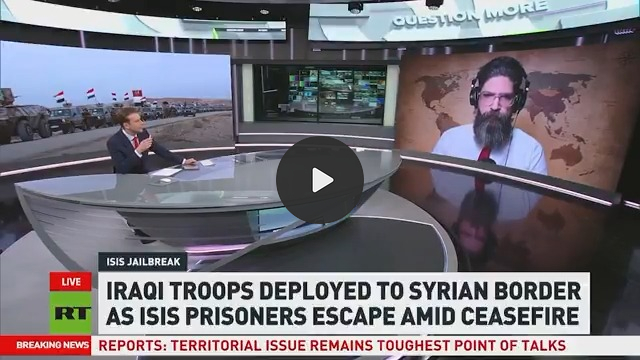
Why? Because when a problem remains frozen, it remains available. It remains a card that can be played later.
That is the uncomfortable part people don’t like to say out loud.
Do I trust the United States with ISIS detainees? No. And not because I believe America is evil. Because there is precedent—plenty of it—for jihadist networks being tolerated, redirected, and instrumentalized when convenient.
If you lived through Syria’s war, you remember the highway.
Northern Syria did not become flooded with multinational jihadists by accident. Turkey opened its borders and allowed thousands of foreign fighters to flow into Syria from all over the world. Everyone saw it. Everyone documented it. And nobody can pretend it did not happen.
The question is not only what Turkey did—Turkey had its own reasons—but what Washington tolerated, what it encouraged, and what it pretended not to see.
Because in those years, jihadists were not merely enemies to be defeated; they were also a pressure card. They were a force multiplier. They were a way to keep the former Damascus government bleeding.
And this is not speculation pulled from thin air. There was a leaked recording from 2015 in which then-Secretary of State John Kerry, speaking privately to Syrian opposition figures, acknowledged that Washington watched ISIS grow and believed it could pressure Assad into concessions, until Russia intervened militarily and changed the equation.
That leak should have been a global scandal. Instead, it was treated like background noise.
But it is central to understanding the present. Once you accept that ISIS growth was, at minimum, tolerated as a tool of pressure, you begin to look differently at any U.S. “management” of ISIS detainees today.
From Syria to Iraq: Why Now? Why relocate detainees now?
We are not speaking about a normal legal process. This is a region entering a new escalation cycle. The pressure on Iran is rising. The talk in Washington is louder. There are constant hints about reinforcements, “deterrence,” and a new posture in the Middle East.
And now, suddenly, the U.S. wants to move thousands of hardened militants into Iraq.
Iraqis remember 2014. They remember what ISIS did when it broke through state lines and social seams. They remember the massacres, the collapse, the panic, the sectarian explosion.
So yes, local concerns are fully justifiable. But my fear is deeper: that this transfer is not simply about trials, but about reshuffling pieces for a broader regional game.
Because if you want to destabilize Iraq, you don’t need to invade it again. You can revive a pocket of jihadism. You can reignite sectarian tension. You can drag the Popular Mobilization Units into an internal security quagmire. You can exhaust Iraqi politics and weaken any force that maintains ties with Iran.
And from that angle, the detainee transfer begins to look like more than bureaucracy. It begins to look like preparation.
There is another layer here that matters: the collapse of the old Syrian architecture.
For years, the U.S. embedded itself militarily with the SDF in territories rich in hydrocarbons and agriculture; oil fields, gas fields, wheat areas, and border crossings. Whatever romantic story people tell about “democratic autonomy,” the strategic reality was simpler: these resources were leverage.
After war and sanctions, Syria needed fuel for electricity, transport, heating, and reconstruction. Syria needed wheat to feed its people. Blocking the former Damascus government from those resources made the sanctions regime bite harder. It kept the country poor and exhausted. It turned economic misery into political pressure.
And who enforced that blockade on the ground?
The SDF, because the SDF was embedded with U.S. forces.
That arrangement could only last as long as it served Washington’s broader objectives. The moment those objectives were achieved, the SDF would become disposable.
This is how empires treat proxies.
Now we are seeing the proof. The moment Assad fell, and the old Syrian army structure collapsed, the U.S. began to step back. The SDF’s usefulness declined. And what happens when a proxy’s usefulness declines? The sponsor leaves.
There is an old saying in our region attributed to Hosni Mubarak: “Those whose only cover is America are naked.” It is cruel, but accurate.
Today, the SDF is learning that lesson in real time, while Jolani’s forces move into areas that were once under SDF control—oil fields, Raqqa, Deir Ezzor—pushing further.
And in the midst of this confusion—prison breaks, detainee transfers, militants on the run—the U.S. is asking us to believe this is simply a humanitarian or judicial move.
I don’t buy it.
The last guy who was supposed to be on trial in Iraq became "President" of Syria.
We’ve seen this movie.
Even if we ignore geopolitics for a second and focus on basic security, the situation is already dangerous.
ISIS detainees have escaped in the past during chaos. On the run today are militants who include foreign citizens, including Europeans who traveled to Syria to join ISIS. If they find safe havens inside Syria or slip into Turkey, the route to Europe is not theoretical. It is known. It has happened before.
And here we hit an uncomfortable European truth.
Europe is alarmed by ISIS when it returns to Europe. But Europe has been far less alarmed when ISIS was exported to Syria.
Years ago, a German public broadcaster reported allegations that German security agencies did not merely tolerate the departure of certain Islamist extremists to Syria and Iraq, but sometimes facilitated it, essentially exporting a domestic problem into someone else’s war zone.
If even a fraction of that is true, then Europe has no moral right to lecture Syrians and Iraqis today about “counterterrorism responsibility.” Because what is being transferred back now is blowback.
And that blowback will not stay neatly contained in the deserts of Syria and Iraq. It never does.
The most neglected part of this entire crisis is not the detainees. It is the children.
Al-Hol camp has become a factory of resentment and indoctrination. Children raised in these conditions, surrounded by radicalized mothers and extremist networks, do not simply “grow out of it.” Many are being shaped into the next phase of instability.
Journalists have interviewed some of these children. Many openly say that when they leave, they want to join ISIS and continue the fight.
So what exactly is the long-term strategy here?
If the West refuses serious rehabilitation programs and refuses repatriation responsibility, if Syria and Iraq are left to manage the security fallout with limited resources, and if regional politics are being pushed toward escalation, then the future is obvious.
We are entering a new phase.
Not a “post-ISIS” phase. A recycled ISIS phase.
And this phase will be more dangerous because the region is not positioned the way it was ten years ago.
In 2014–2015, Iran—through figures like Qassem Soleimani and the networks that helped organize resistance on the ground—played a major role in halting ISIS advances in Iraq, protecting Yazidis and Kurds, and supporting operations that helped prevent total collapse.
Today, Iran is more isolated, under heavier pressure, and fighting on multiple fronts. If ISIS resurges again, it is not guaranteed that the same level of regional backing will exist to contain it quickly.
That means minority communities in Iraq and Syria—Yazidis, Christians, Shia villages, anyone outside the takfiri worldview—will face an even harsher security environment.
And yes, I will say it plainly: the West loves to pretend it cares about Middle Eastern Christians. The reality is that Western wars and regime-change operations have been catastrophic for Christians.
Since the 2003 invasion of Iraq, the overwhelming majority of Iraq’s Christian population has left. Since the war in Syria, huge portions of Syria’s Christians have also fled. You cannot bomb and destabilize societies for twenty years and then pretend you are a protector of minorities.
That narrative is a smokescreen.
Now, let’s be honest about the stakes.
If the detainee transfer to Iraq were part of a serious regional plan—transparent, coordinated, genuinely focused on de-radicalization and justice—it would be one thing. But this is not the environment we are in.
We are in an environment where Washington escalates against Iran, where Syria has been reshaped through jihadist normalization, where proxies are abandoned once their use expires, and where militant networks have been tolerated as instruments of pressure before.
So when the U.S. tells us it is moving thousands of ISIS detainees “for trial,” I hear something else: I hear repositioning. I hear preparation.
I hear the possibility that these militants—directly or indirectly—could be used again to ignite sectarian conflict inside Iraq, weaken Iranian influence there, and then shift pressure toward Iran itself.
And if that sounds “shaky,” ask yourself a simple question: what part of the last twenty years was stable? What part of Western policy in this region has been consistent with its own moral language?
The biggest danger is not that ISIS returns.
The biggest danger is that ISIS returns in a region already exhausted, already fractured, and already being pushed into a new escalation cycle, while Western capitals pretend they are managing “security.”
If we are serious about preventing another 2014, then we need a serious approach: genuine international responsibility, real repatriation programs, real rehabilitation, and real regional cooperation.
But as long as empires treat militants as tools and chaos as leverage, the cycle will continue.
And the people who will pay first—again—will be Iraqis and Syrians.
Then, as always, Europe will pretend to be shocked.
All of my op-eds are freely available, thanks to the generous support of readers like you. Nonetheless, independent journalism takes time, research, and resources. If you find value in this piece or others I’ve published, please consider sharing it or becoming a paid subscriber. Your support, whether big or small, truly matters and helps keep this work going.
—Kevork Almassian is a Syrian geopolitical analyst and the founder of Syriana Analysis.
Thank you. The US is a nightmare for ao many.
Excellent analysis, Kevork. I also wrote a brief post just a few days ago warning that the timing of events signals a clandestine plot to export a new ISIS resurgence to destabilize Iraq: https://adversusbabylon.substack.com/p/we-still-deserve-better-psyops