

When people say the current phase of escalation in the Middle East feel more serious between Washington and Tehran, it’s not because Trump is back to threatening Iran in public—we’ve heard that soundtrack before—it’s because the tempo has changed in a way that should make you uneasy, with “diplomacy” running in parallel to very visible American military reinforcement in the region. Meanwhile, Israel is putting out maximalist demands that read like a public declaration that there is no acceptable deal unless Iran is stripped of the very deterrence tools that keep it from being treated like another Iraq or Libya.
A few weeks ago, I said I did not believe war was imminent. I still think parts of what we are seeing may be meant to persuade Tehran into concessions. But “not imminent” is not the same as “not possible,” and the mood today is different because the pieces are being moved into place, while the public is being conditioned for the idea of a longer military aggression, not a symbolic one-night strike.
Why it feels more serious now
The seriousness is not only in the rhetoric; it’s in the logistics. Aircraft carriers are moved. Additional troops are deployed. Air defenses are shifted. Warships and guided-missile destroyers appear in the region. When you add it all together—especially alongside reports about preperation for longer operations—it produces a different kind of pressure: the kind that tells the other side, “We are building the option, even if we say we prefer a deal.”
At the same time, the diplomacy itself is being framed in a way that is psychologically coercive. Iran is told to come to the table, but also to accept red lines that would make any Iranian state—Islamic or secular, revolutionary or nationalist—strategically naked. This is closer to what I described on stream: a regime transformation project without openly declaring regime change.
That is why the moment feels sharper. The escalatory language is now backed by visible preparations, and those preparations are being narrated to the public through carefully sourced leaks that create the impression of inevitability.
Reuters and the “weeks-long operations”: psy-op or real preparation?
Reuters published a report claiming the U.S. military is preparing for potentially “weeks-long” operations against Iran if Trump orders an attack, citing unnamed U.S. officials.
Now, I want to be honest about how we should read something like this, because we live in an era where mainstream reporting is routinely weaponized as part of psychological operations. When anonymous officials leak “serious” war preparations right before negotiation rounds, it can serve two purposes at once: it can be real planning, and it can be coercive theater designed to extract concessions without firing a shot.
But even if you assume this is partly psychological warfare, you still can’t dismiss it. Empires often use the media as a megaphone to amplify their bargaining position. The message to Tehran is: we are not discussing a limited strike; we are discussing sustained operations that can hit state and security infrastructure, not just nuclear sites. That is a very specific kind of intimidation, because it tells Iran the target isn’t only “military capability,” it’s also “political governability.”
There is another reason the Reuters framing matters. It acknowledges—almost casually—that Iran would retaliate, and that this could become a back-and-forth exchange “over time.” In other words, the public is being slowly acclimatized to the idea that if this starts, it will not be a single weekend of fireworks. It will be a sustained regional crisis with uncertain end points.
And that’s the difference between a psy-op and a plan: a psy-op still requires a plausible plan behind it. You don’t bluff weeks-long campaigns without laying down at least some of the infrastructure that would make them feasible. In that sense, even the bluff is dangerous, because you don’t mass combustible material around a matchbox without increasing the chance of ignition.
Netanyahu’s maximal demands are a “no-deal” signal
This is where Netanyahu’s role becomes crucial, because if you want to know whether diplomacy has a real chance, you look at the demands being set as the price of “peace.”
Netanyahu is not asking Iran to reduce risk. He is asking Iran to abolish itself as an independent strategic actor.
He wants enriched material removed from Iran’s territory. He wants the enrichment capability dismantled. Not paused, dismantled. He wants Iran’s missile range capped at 300 kilometers. He wants the full dismantling of Iran’s regional alliances and networks. And he wants inspection terms that amount to permanent intrusive supervision “in perpetuity.”

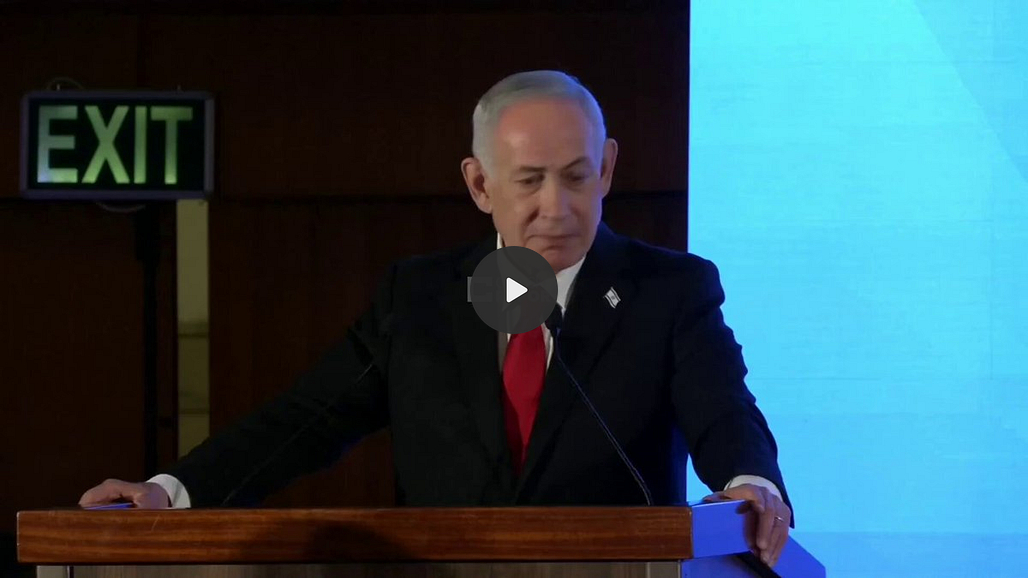
Taken together, this sounds like an ultimatum. Because what is being demanded is not “non-proliferation,” but a unilateral disarmament regime applied to one state while another state in the region—the one making the demands—sits on a nuclear arsenal and refuses even to acknowledge it publicly.
That is why I said on stream that maximalist demands are often the clearest proof that the demanding side is not interested in a negotiated outcome. If you truly want a deal, you anchor your demands in what the other side can accept without political suicide. If you want war—or you want the other side to reject the offer so you can justify war—you set structurally impossible demands.
Netanyahu’s posture, therefore, signals something very simple: “Even if Washington signs something, we will treat it as insufficient.” That is the logic of sabotage. It’s a way to keep diplomacy permanently failing, because the failure is strategically useful.
Nuclear deterrence versus non-proliferation: Israel as an exception
Here is where we need to speak plainly, because many people still want to discuss Iran’s nuclear file in isolation, as if Israel’s capabilities are not part of the same equation.
The nuclear issue is primarily a security logic debate.
If the goal is genuine non-proliferation, then the principle must apply to everyone. You cannot build a regional order where one state holds hundreds of warheads, keeps them outside any formal transparency regime, and then demands “zero capability” from its rivals.
The hard truth is that a nuclear monopoly creates incentives for proliferation. If a state believes it can be attacked—especially existentially—by a nuclear-armed adversary that is politically protected by the global hegemon, then that state will eventually be drawn toward deterrence logic. Even if it does not want a nuclear weapon, it will want the option, the threshold, the capacity to move quickly if survival demands it.
This is why I said something that some people find uncomfortable: in a region where Israel is nuclear-armed, you either pursue true non-proliferation that includes Israel, or you accept that deterrence pressures will remain in place and may eventually produce another nuclear-capable actor. The danger is not “Iran” as an abstract villain. The danger is a regional nuclear hierarchy that institutionalizes permanent inequality and then expects the unequal side to remain passive forever.
This is also why the missile question is not a side issue. When Iran says missiles are non-negotiable, it is saying: if you deny us a strategic deterrent while our adversaries retain theirs, you are asking us to surrender. And when Netanyahu insists on a 300-kilometer cap, he is asking Iran to lose the ability to credibly deter Israel.
Once you understand deterrence logic, a lot of this becomes easier to read: the nuclear file is being used as a vehicle to impose wider strategic submission, and the maximalist framing is designed to make any Iranian acceptance look like capitulation to the public inside Iran.
The real danger of this moment
So where does that leave us?
It leaves us in a moment where the public is being prepared for the possibility of sustained operations, the negotiations are being conducted under a shadow of escalating deployments, and Israel is setting conditions that make an agreement structurally impossible unless Iran agrees to disarm itself while the regional nuclear monopoly remains untouched.
That’s why the situation feels more serious now. Because the military pieces being moved and the narrative being built around them are meant to normalize a longer conflict as a plausible “next step.”
And here is the ultimate irony: if the stated goal is “security,” then the approach being taken is almost guaranteed to undermine it, because humiliating demands and one-sided nuclear hierarchies do not produce stability. They produce resentment, escalation, and the constant temptation for “one more round” of strikes when the first round fails to deliver surrender.
If Washington wants a real outcome, it will eventually have to choose between two paths: either accept a mutual framework where security is not monopolized, or continue treating diplomacy as a tool of pressure until pressure becomes the prelude to war.
Right now, the maximalist signals suggest we are being pushed toward the second path.
All of my op-eds are freely available, thanks to the generous support of readers like you. Nonetheless, independent journalism takes time, research, and resources. If you find value in this piece or others I’ve published, please consider sharing it or becoming a paid subscriber. Your support, whether big or small, truly matters and helps keep this work going.
—Kevork Almassian is a Syrian geopolitical analyst and the founder of Syriana Analysis.
Spot on, Kevork.
If Israel, the US and Western vassals get away with this, then the global control they crave is a huge step closer; that is why Russia and China are providing support - apparently they are trying now to help Cuba, too.
The psychopaths gambling with so many lives do have weaknesses; they are not the industrial powers they were in 1945 and Russia and China can now outmatch them on that front.
This is existential for the world.
We hope some sanity might prevail but after Rubio's recent speech basically calling for the reintroduction of Colonialism it does not look good.
Unless the Israeli and Western elites and structures are made to face consequences they will just continue to flail around violently at will wherever they choose.
Typical psychopathic Zionist behaviour.